


























Samsung Electronics has begun mass-producing Nvidia’s Groq 3 inference chip using its 4-nanometer foundry process, the companies announced at Nvidia’s GTC 2026 developer conference.
The deal cements Samsung’s foundry division as a key supplier in the AI inference market and marks a major step in Nvidia’s $20 billion strategy to diversify beyond graphics processing units. Nvidia CEO Jensen Huang confirmed the production milestone during his keynote address to more than 18,000 attendees at the SAP Center in San Jose, California.
The Groq 3 chip originates from Nvidia’s licensing agreement with AI startup Groq, finalized on Christmas Eve 2024. Nvidia absorbed Groq’s core technology and recruited founder Jonathan Ross and other key personnel as part of the deal. Huang compared the integration to Nvidia’s 2019 acquisition of Mellanox, positioning Groq technology as a complement to its GPU lineup.
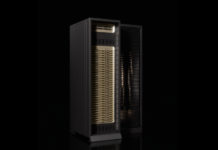
The Groq 3 Language Processing Unit uses on-chip SRAM rather than traditional high-bandwidth memory, enabling faster data transfer and improved power efficiency for inference workloads. Nvidia plans to deploy the chips in LPX inference racks containing 256 LPUs with 128GB of on-chip SRAM, available in the second half of 2026.
Amazon Web Services announced it will deploy Groq 3 LPUs alongside more than one million Nvidia GPUs as part of an expanded partnership, according to the announcement.
Samsung has ramped production from approximately 9,000 wafers to about 15,000 wafers as output shifts from samples to large-scale commercial manufacturing, according to industry sources cited by TrendForce.
Samsung also showcased its HBM4E high-bandwidth memory chip at GTC, displaying the physical chip and core-die wafer for the first time. The seventh-generation HBM4E is designed to deliver speeds of up to 16 gigabits per second per pin and bandwidth of 4 terabytes per second. The company’s sixth-generation HBM4 is already in mass production for Nvidia’s Vera Rubin AI platform.
A Samsung source told the Chosun Ilbo that Samsung is “the only company that can provide a total solution by connecting and supplying multiple core components within an AI server.”
The announcements highlight mounting competition in AI inference, where Google and Amazon have developed custom chips to challenge Nvidia’s market position. Huang projected at least $1 trillion in cumulative AI chip revenue from 2025 through 2027.
Featured image credit